Is one too few for your best?
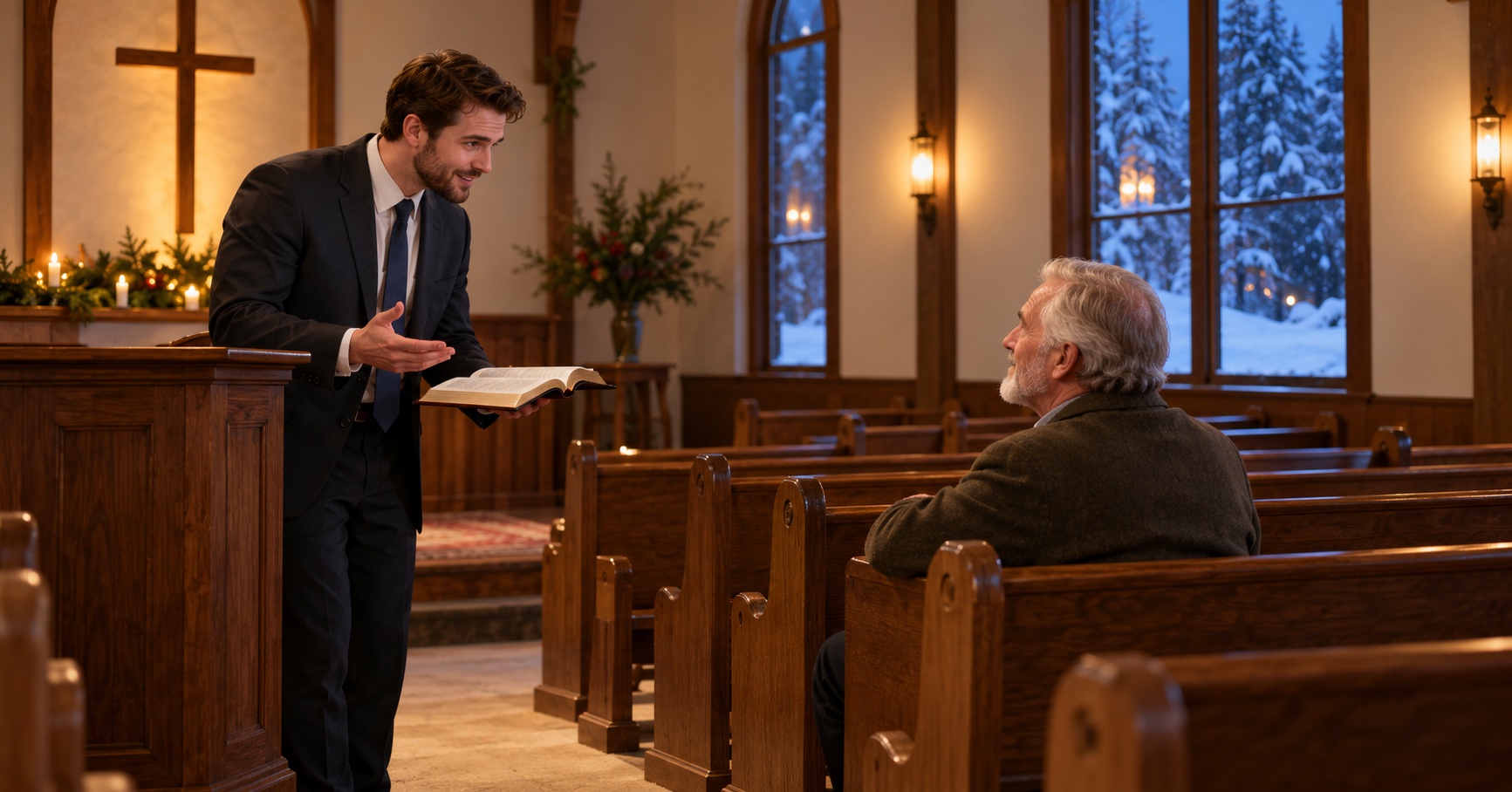
One snowy Sunday evening, I decided the crowd wasn’t big enough to deserve one of my best sermons. I preached an old one instead. I was twenty-three, and I thought that was good judgment. Three conversations of Jesus eventually led me to reconsider. In this post, I share how my minimum audience became one—and why that one person deserves what I came prepared to teach.
It was in January 1969. It was my second month as the preacher for the Madisonville Church of Christ in Madisonville, Kentucky.
After the morning service, the elders, E.E. Holly, Carl Price, and Ed Riadon, told me they were going to the opening service of the new building in Henderson, Kentucky. They asked me if I’d like to go with them. I was glad to be invited.
We had a good service. I met many new people from the area.
As we were driving back, it started to snow. The more we drove, the more it snowed. It became clear that travel would be difficult for the services in Madisonville that night.
I began to think about the sermon I had selected for that night. It was one of the best sermons I had ever prepared.
The more we drove, the more it snowed. I knew that the more it snowed, the fewer people would be at the services that night.
In my 23-year-old wisdom, I concluded it would be a shame to waste such a great sermon on a small audience.
We arrived back in time for me to choose an old sermon that wasn’t as good as the one I had planned, and I preached it that night.
But I do remember what convicted me.
Over the years, as I studied the Gospels, I began paying closer attention to three occasions when Jesus taught some of the most important principles ever spoken.
And in each case, His immediate audience consisted of just one person.
The first example is found in Luke 19, when Jesus went to the home of Zacchaeus.
After listening to Zacchaeus, Jesus declared that salvation had come to his house that day. Then Jesus announced His purpose for coming into the world:
“For the Son of Man has come to seek and to save that which was lost.” — Luke 19:10
Think about that statement. Jesus declared the purpose of His mission in the setting of a personal encounter with Zacchaeus.
One person was at the center of that conversation.
The second example is found in John chapter 4.
Jesus and His disciples came near Sychar, a city of Samaria. The disciples went into the city to buy food while Jesus rested beside Jacob’s well.
A woman came to draw water, and Jesus asked her for a drink.
She was surprised that a Jewish man would speak to her.
What followed was a remarkable conversation about living water, eternal life, and acceptable worship.
The woman raised a question about the proper place to worship God. Jesus responded with truth that remains fundamental to our worship today:
Jesus said to her:
Woman, believe me, the hour is coming when neither on this mountain nor in Jerusalem will you worship the Father. You worship what you do not know; we worship what we know, for salvation is from the Jews. But the hour is coming, and is now here, when the true worshipers will worship the Father in spirit and truth, for the Father is seeking such people to worship him. God is spirit, and those who worship him must worship in spirit and truth. — John 4:21–24
What a powerful lesson on one of the most important subjects in the Bible!
His audience for that conversation? One woman.
The third example is found in John chapter 3.
A man named Nicodemus came to Jesus at night.
During their conversation, Jesus taught him a fundamental principle about entering the kingdom of God.
Notice these statements in John 3:3 and 5:
“Truly, truly, I say to you, unless one is born again he cannot see the kingdom of God.”
“Truly, truly, I say to you, unless one is born of water and the Spirit, he cannot enter the kingdom of God.”
Jesus was discussing one of the most important matters any person could consider—entering the kingdom of God.
His audience for this fundamental teaching? One man.
After reflecting on these passages for several years, I established a rule that I still follow. My minimum audience for preaching a sermon, teaching a Bible class, or leading a workshop is one person.
If nobody shows up, I’m not going to talk to myself. But if one person shows up, I intend to deliver the message I came prepared to teach.
I have never prepared—and could never prepare—a lesson more important than what Jesus taught in those three conversations.
And Jesus was willing to teach those to one person at a time.
Year before last, I was scheduled to lead a three-day workshop on interim ministry at Heritage Christian University. On the Friday before the workshop was to begin, I received a call from a brother who had enrolled.
He asked, “How many people are coming to the workshop?”
I replied, “You’re the one who’s enrolled.”
He very kindly responded, “That’s okay. I’ll wait until the next workshop. I look forward to it.”
I told him, “We’re planning to start Tuesday morning at eight o’clock. I’ve been saying for years that my minimum audience for a gospel meeting or workshop is one. As long as one person shows up, I plan to deliver what I’ve prepared.”
He was there the next Tuesday, and we had a workshop with him included.
As I reflect on my years of ministry, I realize that some of the most important conversations I’ve ever had involved only one other person.
I remember several people who called me or came to my office while considering suicide. We talked about their problems, their choices, and the consequences of those choices. Following those conversations, each decided not to carry out the plans they had described.
Another conversation stands out in my memory.
A sister came to discuss, in considerable detail, how she was planning to kill her husband.
I had concluded that sometimes people don’t sin because they think about sinning. People sin because they don’t think about sinning enough.
During our conversation, we discussed her options and what might follow from each one. We talked about the consequences for her, her husband, her children, the church, and others whose lives would be affected. By the end of our conversation, she had reconsidered her original plan.
I count that as one of the most important Bible classes I’ve ever taught. I cover that story in detail in two podcast episodes.
Why do people make bad decisions? 1: https://www.buzzsprout.com/2369804/episodes/15882305
Why do people make bad decisions? 2: https://www.buzzsprout.com/2369804/episodes/15885017
Jesus taught that a person’s soul is worth more than the whole world.
For what will it profit a man if he gains the whole world and forfeits his soul? Or what shall a man give in return for his soul? — Matthew 16:26
Think about that.
If one soul is worth more than the whole world, how could one person ever be too small an audience for our best? I once thought it would be a shame to waste a good sermon on a small crowd.
Jesus knew what one person was worth.
The next time only one person shows up, will my preparation and attitude demonstrate that I know it, too?

Listen to Gleaning Mustard Seeds Podcast
Click on the Pictures