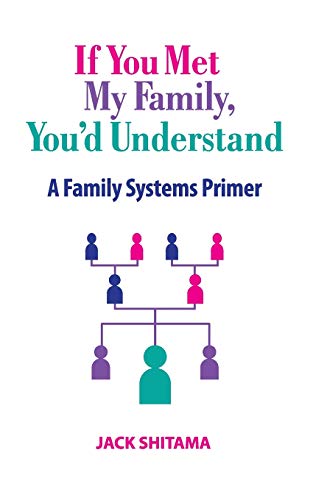
Book of the Quarter: If You Met My Family, You’d Understand: A Family Systems Primer

If You Met My Family, You’d Understand: A Family Systems Primer, by Jack Shitama, © 2020 by Jack Shitama, © 2020 by Jack Shitama; Published by Charis Works, Inc. Earleville, Maryland; ISBN 978-1-7320093-9-4 (Ebook)
On the fifth Tuesday of each quarter of the year, I share a book I’ve read recently. I highlighted “mustard seeds,” which impressed me. I hope you find one or two that will be helpful to you.
To find more information or buy this book on Amazon, click the link or the picture below:
As an Amazon Associate, I earn from qualifying purchases. There is no additional charge to you
Here are the “mustard seeds” I highlighted:
You cannot avoid a challenge or help others avoid it. The best thing you can do is face it as a non-anxious presence (page 13, Kindle Edition)..
Be aware of how you are avoiding a challenge, and whether this is making it worse (creating a problem), rather than helping (page 13, Kindle Edition).
There is a difference between knowing what you believe and the need to have others agree with you. The need to be right creates anxiety. Have you ever had an argument with someone because the fact that they disagreed with you made you anxious, even angry? This is how a challenge becomes a problem (page 14, Kindle Edition).
Effective leaders are able to express what they believe while giving others the freedom to disagree. This requires self-differentiation (page 16, Kindle Edition)..
A self-differentiated person is someone who is able to act according to her own values, while staying emotionally connected to others in the system, even when there is pressure to conform to the values of the system (page 16, Kindle Edition).
The ability to self-define in non-anxious ways when there is pressure to conform is the essence of self-differentiation.
The Non-Anxious Presence
Self-differentiation manifests itself in the ability to be a non-anxious presence, especially when there is surrounding togetherness pressure. This doesn’t mean you don’t feel anxious inside; it just means that you are able to regulate it in a way that doesn’t poison the system. To understand a non-anxious presence, it is helpful to know what it is not. It is not a non-anxious non-presence. It’s easy to be non-anxious when you are not emotionally connected (page 18, 19, Kindle Edition).
All change is loss. And with loss comes grief (page 21, Kindle Edition).
“No pain, no gain” is an idea most often associated with athletics or fitness. This is true of emotional health as well. If all change is loss, and loss involves grief, then the path to emotional well-being is directly through pain. Loss is painful, but it creates a growth opportunity (page 22, Kindle Edition).
It is actually our inability to withstand the pain of others that causes problems in our family of origin, congregation, or organization (page 23, Kindle Edition).
When you choose to encourage strength in others, rather than comforting weakness, you are helping both them and you (page 24, Kindle Edition).
One of the ways we avoid pain is through replacement. To the extent that we avoid dealing with our grief by replacing the loss, we lose the opportunity to grow (page 25, Kindle Edition).
“You can change yourself and you can change the situation but you absolutely cannot change other people. Only they can do that.” — Joanna Trollope (page 31, Kindle Edition).
A triangle occurs when two people become uncomfortable in their relationship and they focus on another person or issue to stabilize it (page 31, Kindle Edition).
When you try to change the relationship of the other two sides of a triangle, it not only strengthens the triangle, but you also will end up with the stress of the situation (page 35, Kindle Edition).
The goal of a self-differentiated person in any system is to take responsibility for oneself and no one else, while remaining connected to others in the system, especially the most anxious (page 42, 43, Kindle Edition).
Nobody gets the problem they can handle. If we could handle it, then it wouldn’t be a problem. It’s often our super serious efforts to deal with a challenge that makes it a problem (page 78, Kindle Edition).
Paradox is like this. Instead of giving someone the fight they’re looking for, we go in the opposite direction. Don’t argue, and don’t agree. It is doing the opposite of our own instincts (page 82, Kindle Edition).
For more information or to purchase this book on Amazon, click on the picture below or this link: https://amzn.to/4gzJxyN

Have you read or heard Gail’s book?



Thanks for sharing. The author sounds like a disciple of Friedman or Bowen.
Yes.